
Guest Author: Rebecca Reber
Back in the olden days when I was a kid, most women in books played one of four crucial roles: paragon of virtue, loving caretaker, arm candy, or harpy. Even in kids’ books, when a girl was the protagonist she fit into one of these roles (although usually only the first two, unless you’re counting Lolita or the myth of Perseus). Because of the limited nature of these roles, female characters were, more often than not, one-sided and not very interesting at best, and at worst insulting and mean-spirited.
I bless the day that all this changed. I can’t point to an exact time in the past 35+ years when this happened, but I realized how completely the narrative, literally, was different when I read Daughter of the Deep by Rick Riordan. (I talk more about it below.) It’s now almost unthinkable to have a book, especially one written by a woman, where the women in it are marginalized or only seen as one-sided. All of these books are perfectly ordinary by today’s standards, and none of them feature a bland or belittling female protagonist.
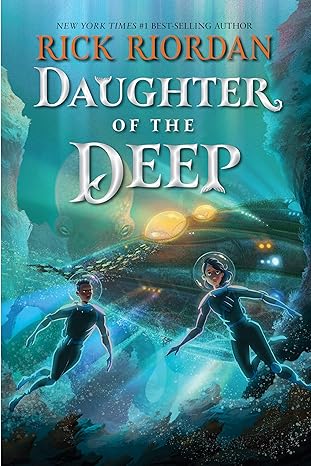
by Rick Riordan
(Middle Grades/YA, Science Fiction)
Ana Dakkar is about to finish her freshman year at the prestigious Harding-Pencroft Academy, where the best and brightest are trained to become marine biologists or naval warriors. Ana and her classmates face the last challenge of the year, a trial at sea where the students, accompanied by one teacher, run the entire trip. This means that Ana, as the descendant of a famous sailor, is in charge of everything. But then disaster strikes and this class of elite freshmen have to fight for their very survival.
As I mentioned, this was the book that solidified for me the positive changes that are now a given for female protagonists. The inciting incident for this paradigm shift in my brain? Ana has her period while on the sea trial and it knocks her for a loop for a few days. Such a mundane detail, but it was notable for me because it is so mundane. And now it’s talked about in a middle grade novel!
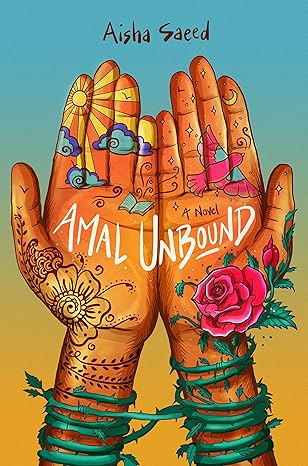
by Aisha Saeed
(Middle Grade, Realistic Fiction)
The title character Amal is a young girl growing up in Pakistan. Like many young girls, she dreams of going to college and getting a good career. Amal wants to be a teacher because she wants to change students’ lives, just like her teacher has inspired her. However, when her temper gets her into serious trouble, Amal’s life changes so completely that her dreams of college and career seem gone forever.
What happens to Amal is not something that would commonly happen in the United States, but is apparently a thing even today in Pakistan. I was shocked to learn that it’s an issue that affects as many as 25% of children under the age of 18! However, the narrative shows Amal in such a beautifully patient light that it helps you get through the darker parts of the story.
Amal is passionate and flawed and full of love. She’s patient when she needs to be but hates injustice, and she’s unfailingly loyal to her friends and family. You’ll probably get used to this, but please check trigger warnings if you think topics might be an issue for you or a child.

by Alan Bradley
(Middle Grade, Mystery)
I love Flavia. She’s growing up in 1950s England, the youngest of three girls, to a noble family whose best days are behind them. Her mother died when she was a baby and the lonely and somewhat neglected Flavia, who is curious and intelligent, throws herself into the study of chemistry. She inherited a complete and up-to-date chemistry lab from her great uncle Tar, and it’s full of everything the budding mid-century chemist would need.
In the first installment of this series, a dead man turns up in the DeLuce garden, holding a rare postage stamp in his hands. As the police get involved, Flavia realizes that her chemical know-how could help them solve it. Do they want her help? No, they do not. But Flavia is tenacious to a fault and starts up an independent investigation into the murder. The book is written in first person present POV, and Flavia’s voice is quirky and charming. I strongly recommend the audiobook for the whole series.
Children’s lit is full of lonely and intelligent young girls, but Flavia stands out because she develops a hobby that truly engrosses her, uses all of her gifts, and actually helps people. She also refuses to use her loneliness as an excuse to withdraw or turn surly. She’s funny, thoughtful, insightful and both loves and hates her older sisters. I find her absolutely delightful.
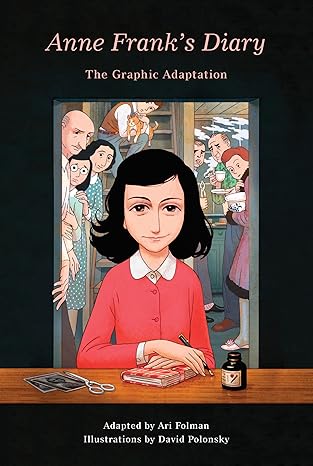
by Anne Frank (contributor), David Polonksy (Illustrator), Ari Folman (Adapter)
(Middle Grade
You may think you’re familiar with Anne Frank’s story, but this graphic adaptation shows a deeper, darker and more realistic Anne than the one published in 1947. Her father Otto famously sanitized her diaries when he found them after WWII, which is understandable. He was grieving and traumatized, and probably still saw Anne as a little girl. However, the diaries she actually left behind were grittier and showed Anne as a real teenager, full of angst, sexual curiosity, and despair. Her feelings understandably fluctuate between deep compassion and hatred toward those who are killing her people. She’s also a teen – her period starts and so do (suppressed) sexual desires.
While exploring more intense sides to Anne, through pictures and words, the funny and loving parts of Anne are still present. She optimistically says that she believes the world is full of good people. She longs for the day when she and her family will be free to resume their lives. And she’s excited by the thoughts of her possible futures after the war. I think this more complete portrayal of Anne is both refreshing and more heartbreaking.
NOTE: If you’re uncertain about whether this book is suitable for your children, please read the trigger warnings before you read. But also remember that other children will certainly benefit from it. And so will adults.

by Angeline Boulley
(YA, Realistic Fiction/Crime Fiction)
Daunis Fontaine is an 18-year-old unenrolled member of the Ojibwe tribe and lives in northern Michigan. She’s just graduated from high school and starts attending college nearby in order to stay close to her family. While not completely carefree, Daunis enjoys her life, especially when she meets Jamie, who plays for the local hockey team. However, after witnessing a terrible tragedy, Daunis feels like her life is spinning out of control. And it turns out that Jamie is also hiding a secret that will change how she sees him.
I know this sounds like a romance, but it’s not. It’s actually a gripping coming-of-age novel with a strong crime solving element. Daunis faces some incredibly ugly things over the next few months and it’s not her relationship with Jamie that gets her through it, but rather her family and her heritage, things that she’s been able to rely on her whole life.
NOTE: This one also has trigger warnings that you might want to take a look at.
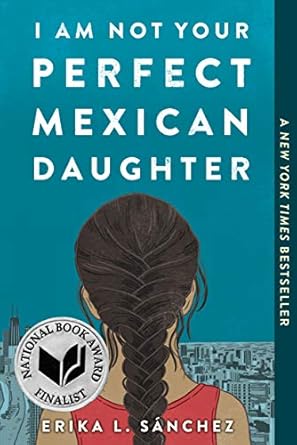
by Erika L Sanchez
(YA, Realistic Fiction)
Let me begin this by saying that I am not Latina, and I don’t want to give the impression that I’m coming from a place of cultural knowledge. That said, this novel contains a lot of cultural references that help to contextualize Julia’s experiences for those of us who don’t share her background and circumstances.
Julia Reyes is not a perfect daughter; that was her older sister Olga, whose funeral the book opens with. Julia wants to leave home and go to college, have a career instead of getting married, and see the world, all of which baffle her undocumented parents. Olga didn’t want to do any of those things. Olga was living at home until ready to marry her “nice Mexican boy” fiance.
While deep in her grief at Olga’s death, Julia comes across some clues in Olga’s room that hint at a secret life her sister might have had. Maybe there was more to Olga than anyone thought.
This is another coming-of-age novel that is honest and raw. We get Julia’s thoughts as they happen, letting us see many different parts of her character. Sometimes she is insightful, sometimes annoying and angsty, but always interesting. Again, check trigger warnings if you worry about them before your child reads this.

by Shannon Chakroborty
(Adult, Fantasy)
Amina is middle-aged and a retired pirate. She wants to live a quiet life caring for her young daughter and her aging mother. Quite sure her adventuring days are behind her, she is also a devout Muslim, which she references often.
However, one day the mother of one of her former shipmates blackmails Amina into again taking up her seafaring ways in order to save the shipmate’s daughter, who has been kidnapped (or run away with) a sorcerer. In record time Amina steps back into that world, sailing the Indian Ocean and other mythical places to try to save the missing girl.
What do I love about this book? First of all, Amina is not a young woman. Second of all, she leaves her family reluctantly and can’t wait to get back to her daughter. Third, she is actually really good at pirating. She retired when she was at the pinnacle of her career, for reasons that had nothing to do with her enjoyment or abilities. And while a devout woman, Amina is very open about her love of sex. In fact, she mentions it several times, usually in conjunction with a certain husband or another. What’s not to like, and maybe even want to emulate, in such a protagonist?
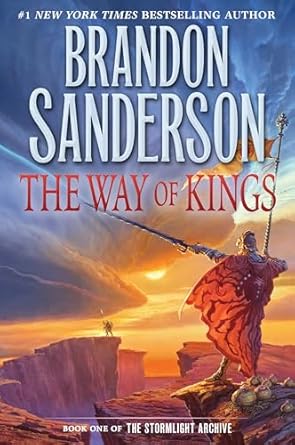
by Brandon Sanderson
(Adult, Fantasy)
The Stormlight Archive books are full of characters, male, female and unspecified. However, the two I want to focus on are Navani Kholin, the king’s mother, and Shallan Davar, a young scholar.
Shallan comes from a highly regulated and controlled background, where she wasn’t allowed to leave her father’s estate. However, when we meet her she has left the estate for reasons that involve saving her family’s reputation and livelihood. In the first book, The Way of Kings, Shallan realizes she can do hard things and use her wits to save herself and others. As the series continues, we get to see Shallan grow even more, becoming a true heroine. However, she is also deeply flawed, dealing with past traumas in ways that are not helpful at all. I can’t help but love her.
Navani doesn’t enter the story until toward the end of The Way of Kings, except as a mention that she’s the king’s mother. However, as soon as she steps onto the scene, we realize that she is the first true love of one of the other characters, and that she’s a gifted inventor. While suffering a bit from the paragon of virtue trope, as the series progresses her character development also progresses, and she’s truly the person I want to grow up to be like.
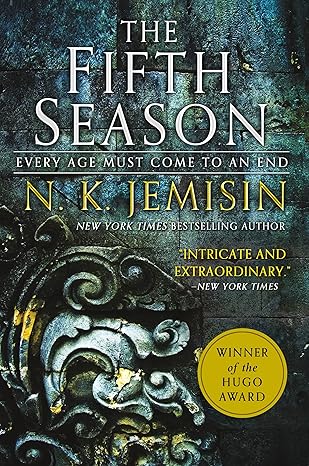
by N.K. Jemisin
(Adult, Fantasy)
Essun is a mother and an orogene, a person who uses the life force of living things to control seismic powers. However, because orogenes are so powerful they are also discriminated against, even killed. The first time we meet her, she has just returned home to find that her husband has killed her youngest child and taken off with her oldest, probably because he realized that the children are also orogenes. Essun then begins an arduous journey to find and save her daughter before disaster strikes. As she travels, we find out that Essun had a layered and interesting past, one that we learn about very slowly.
I like Essun for several reasons: she spends a long time trying to both overcome and atone for her past, she is a dedicated mother willing to put her own interests on pause in order to help her children, and she’s incredibly brave, placing herself in danger multiple times and in terrifying ways so that she can save her child.
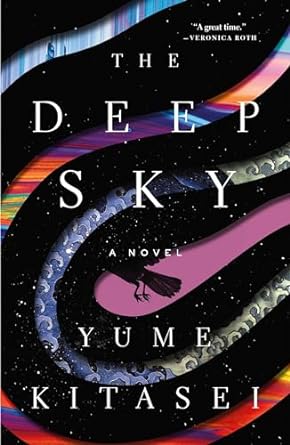
by Yume Kiasei
(Adult, Science Fiction)
On the first of many generation ships to leave earth in order to save humanity, our main character Asuka must solve a murder when an explosion kills three out of the 80 crew members. Asuka’s task is complicated by her outsider status on the ship. She is the only alternate in the crew and also the only one who can’t get pregnant – the crew is all physically female so that they can create as much diversity as possible in the future population by using a sperm bank – plus as an alternate, she has no clear role on the ship, instead doing whatever job she’s asked to do.
Back at home, the instability of the rapidly increasing climate crisis destroys earth’s leadership structure, which means this ship will be the only generation ship to leave. Knowing this, Asuka must solve the mystery while not destroying the culture of trust the crew relies on to function.
Asuka is a very complicated character. She suffers from anxiety, and past trauma makes her less trusting in her own insights. Because she moves from task to task around the ship, she knows how all of it works and yet doubts her place in the crew. And being seemingly the only infertile crew member has her questioning her very right to exist. Ironically, however, it’s these perceived weaknesses that become her greatest strengths.

by Kim Michele Richardson
(Adult, Historical Fiction)
This historical fiction novel is set in Kentucky during the Depression and features one of the famous “book women” who were hired by the government to take library books out to remote parts of the Kentucky mountains. The fictional Cussy is also a member of the blue people who had actual blue skin due to a rare blood disorder. Cussy, then, finds prejudice toward her for two reasons: she works for the government and she has non-white skin in the Jim Crow south. How she navigates the prejudice and distrust aimed at her is, like any story of the book women, incredibly awe-inspiring and troubling.
Cussy’s father is blue-skinned and her mother was white. When her father’s hours are cut back at the local mine, Cussy realizes that she needs to find a job to help make ends meet. The Pack Horse Librarian project seems perfect for her because she loves books and talking about them, and she understandably prefers to spend lots of time alone.
One of the things I adore about Cussy was her capacity for generosity and patience. Even when people are cruel to her, she can still reach out with love and the offer of knowledge through the books she carries with her. There is a bittersweet romance in the book, which was my least favorite part because of how it was resolved. There are also some incredibly difficult scenes and subjects. I would recommend looking at trigger warnings before picking it up. Despite these, I loved the book.
by Jane Austen
(Adult, Classic/Romance)
Written in 1815, Emma is an exception to the classic tropes about women that proves the rule. Emma Woodhouse is beautiful, yes, but she’s also well-educated and the heir to her father’s large fortune. She is a society leader with many close friends, but she’s also completely clueless (yes, that movie) about what is really going on in the minds of those closest to her.
Emma sees herself as a supremely successful matchmaker because of the marriage between her governess Miss Taylor and their widower neighbor Mr. Weston that the novel opens with. Because of her perceived success, Emma then sets her sights on marrying off Mr. Elton, the new village vicar. As his potential match, Emma turns to her new friend Miss Smith, a local student several years younger than Emma herself. Emma then begins to bring Mr. Elton and Miss Smith together on as many occasions as possible, while also beginning to have feelings for Mr. Weston’s son Frank Churchhill.
The book has a somewhat large cast of characters for being about a small village, but Austen skillfully develops them and weaves their stories together in a satisfying and hilarious way. Austen herself famously called Emma a “heroine whom no one but myself will much like.” Fortunately, Austen was wrong. I find Emma delightful: funny, strong-minded, curious, charitable and having the best intentions. I think you will too.
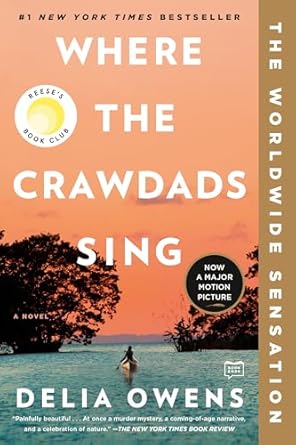
by Delia Owens
(Adult, Realistic Fiction/Mystery)
Kya Clark lives in the marshes outside of a fictional small town in North Carolina. She is left to increasingly fend for herself after first her mother and then her siblings leave home because of the father’s abuse. When her dad finally leaves the swamp himself, Kya can finally bury herself in the wildlife of the marshes that she loves. Although illiterate for most of her childhood, she quickly learns to read when her friend Tate teaches her. She then starts keeping copious notes on the watery world she lives in; these notes ironically get her noticed by the outside world.
One of the people who take a special interest in her is the town golden boy Chase Andrews, whose murder scene opens the story. The book has a dual timeline, one that follows Kya as she grows up and one following the investigation of Chase’s murder because, of course, the town outcast is immediately charged with the crime.
Part lyrical description of the natural world, part slow-burn mystery, Where the Crawdads Sing is an atmospheric read that I think you’ll enjoy. Again, check trigger warnings on this one.
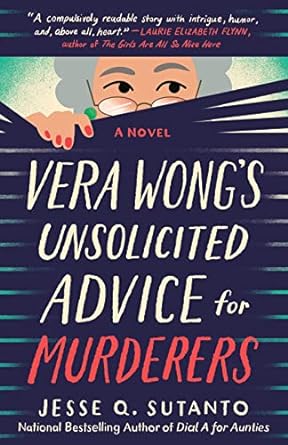
by Jesse Q Sutanto
(Adult, Mystery)
Vera Wong owns and runs a, in her words, “world-famous” teahouse in San Francisco’s Chinatown. Sadly, the teahouse is down to one regular customer and Vera’s only activities are serving the one customer and stalking her single son on social media – she wants grandchildren! When a dead man turns up on the floor of the teahouse, Vera is sure that she’s the only person to solve the crime, especially when the police claim it’s an accidental overdose. Nevermind that Vera stole evidence from the scene; she knew law enforcement were incompetent.
Of course, Vera can’t solve the crime on her own, so several other characters enter the story. They are also sweet and quirky by turns, and help Vera see many things in a clearer way. Vera’s son even makes an important and key appearance in the story, much to his mother’s delight and chagrin.
There are several reasons I love this novel: Very Wong is a woman of a certain age (she’s 60), the mystery is very compelling, and this is a funny book! It’s true that Vera is bossy and always right, except when she’s not, but I still found her delightful. I think you will, too.
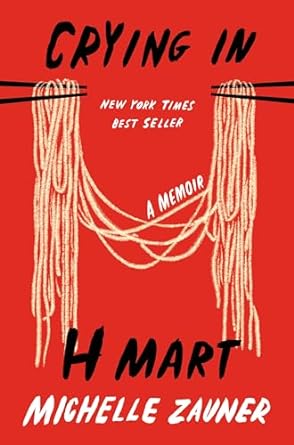
by Michelle Zauner
(Adult, Memoir)
Michelle Zauner writes her memoir by both beginning and ending in H Mart, an Asian supermarket, crying over her mother’s untimely death from cancer. Using a dual timeline, she then tells the story of her life with her controlling mother Chongmi, who was also a gifted cook, both before and after Chongmi’s death.
Zauner found a way to relate to her difficult mother by becoming a foodie, just like Chongmi was. One of her early memories is of eating live, wriggling octopus tentacles, to the delighted squeals of her mother and aunties. When Chongmi’s cancer becomes too much for her father to cope with alone, Zauner moves in to help with care. She tries recreating childhood dishes in the hope of tempting the increasingly sicker Chongmi to eat something, but what Zauner gets out of it instead is a better understanding of her mother. “The culture that we shared was active, effervescent in my gut and in my genes, and I had to seize it, foster it so it did not die in me … If I could not be with my mother, I would be her.”
This is a beautifully written and emotionally wrenching memoir that also had me crying, just without H Mart. I also recommend the audiobook of this because it’s read by the author.
 Releasing the Notes
Leave a comment