
Trigger warning: This post contains content about depression and suicidal thoughts.

It’s July in the USA, we are thinking about anthems.
The National Anthem is of course a classic. While we usually stick to the first verse, the other verses are pretty awesome as well. The first four verses were written by Francis Scott Key during the Revolutionary war, but there is a fifth verse that was actually written during the Civil War by Oliver Wendell Holmes Sr.

It’s got some cool history.
But I have also been thinking about other anthems.
Not like replacing the anthem, like when there was an ill-fated petition to replace the Star Spangled Banner with Party in the USA.
Rather, just thinking of anthemic songs.
If you are a fan of Blink 182, they released Anthem Part 3 this last year as part of their reunion album One Last Time. It’s a beautiful song, really the pinnacle of their anthem series.
And it is hard to think of anthems without including The Anthem by Good Charlotte.
Those ones were obvious because they included “anthem” in the name of the song. What is it that really makes a song an anthem? I looked it up, and Oxford had this to say:
“A rousing or uplifting song identified with a particular group, body, or cause.”

It was pretty easy to think of some from my high school days:
Fall Out Boy – Sugar, We’re Going Down Swinging
All American Rejects – Move Along
Blink 182 – What’s My Age Again
My Chemical Romance – Welcome to the Black Parade
Taking Back Sunday – Cute Without the E, Cut from the Team
Brand New – Jude Law and the Summer Abroad
Hawthorne Heights – Ohio is for Lovers
Those songs sent me down a rabbit hole of nostalgic music I could live in. Pop punk and Emo music were my life in high school.
But I had a rough time thinking of a newer anthem. The latest one I could think of was I Wanna Get Better by Bleachers. And honestly, it is one of the better songs that I have connected with emotionally in the last 15 years.
There was a solid six months where I would blast this through my car stereo on my way to work and sing out loud about wanting to get better. Honestly, it was also at a time in my mental health journey where I was making significant progress in dealing with my traumas. I was working through grief, and exploring the unhealthy coping mechanisms I used.
Most importantly I was addressing and challenging my suicidal thoughts.
I had kept a lot of that side of me private. Of course I had mentioned it to my wife before we were married, I thought it was only fair. I don’t know that I really knew how bad it was then, or at least I was still in denial.
I had told my parents exactly once. It came out as part of a fight I had with them, and it was never mentioned again by any of us.
I honestly think if the people around me had known the warning signs, it was pretty obvious I was struggling even as far back as the sixth grade. I can only think of a few people who addressed it directly with me during high school, and other than that it was just ignored.
The first person to address it with me wasn’t even a close friend. We hung out occasionally as parts of larger groups, but I can only think of one conversation that we had between just the two of us. At the end of our gym class we were in the locker room changing out of our gym clothes. I was always really body conscious, so I had gotten very good at changing quickly. After I was dressed, I just sat on the bench that faced my locker with my head in my hands staring down at the tile floor. He came and sat next to me, and I knew it was him because of the heavy clatter of his wallet chain on the bench next to me. He had noticed how bad I had looked during class, and was asking if I was good.
We chatted for a minute, I don’t remember what all was said, but I do remember that as the bell rang to end class he leaned in and said, “Dude, you are effing depressed. You need to see someone before you kill yourself.”

In his odd, gritty way he had said more to me than anyone else ever had. I had talked to friends for years about wanting to end it all, and it was usually an awkward moment between us that quickly passed as I sensed the discomfort and changed the topic. Michael was the first one to sit with me in my pain and not make it awkward. I really appreciated him, and I felt seen.
Then there was a girl who I was sitting next to on a two hour bus ride who made space for me to share (and honestly, I definitely over shared) and genuinely listened. She didn’t shy away from the difficult parts of my stories, and kept eye contact as I opened up the painful parts of myself. She let me know that even though parts of my story were hard to listen to, they still mattered. She was willing to accept me, flaws and all.
The last I remember clearly was with a religion teacher. I had what I now understand as an anxiety attack at the beginning of one of his classes, and left class to go sit in the bathroom and have a breakdown. He had noticed that I left, and once he had the class going on something they could do on their own, he came in and brought me back into his office. He sat and talked with me about everything going on, not once making it seem like he was in a hurry to get back to his class (though I’m sure he was feeling some pressure to), and after we had talked he had me just sit in his office to gather myself. He checked on me a couple of times through the course of the class, and after class he came in and made a point to make me feel important and loved.
That teacher doesn’t teach anymore, but he does do these cool “Ask Pops” videos where he teaches some basic skills. Here is one, I hope you can see how kind-hearted he is. I know I feel it, but I worry that is just because of an emotional connection I have to him:
When I think back to these three conversations, I think the important thing for me was that they didn’t try and guilt me into feeling better. It is astonishing to me how often that happens, when someone finds out that I struggle with harmful thoughts and they turn immediately to using guilt as a tool:
“You couldn’t do that to your family.”
“Other people have it worse.”
“That is such a selfish way out.”
While these statements are well-meaning, and mostly true (I’ll address the idea of selfishness in a second), they all focus on other people and how I would affect their lives. When someone is thinking about suicide, I promise you that the last thing they need is to be made to feel guilty. This class of statements all have a common thread – your thoughts and feelings do not matter as much as the thoughts and feelings of those around you.
And to claim it as selfish or cowardly couldn’t be further from the truth. The state of mind they are in says “They will be better off without me.” It is the idea that in sacrificing themselves as the burden they are, they will make the lives of those around them easier. Of course they know that it will initially be painful, but that pain can be seen as temporary compared to the burden they would lift. I don’t agree with that idea, but I also understand the feeling. So it is often misconstrued to be an act of kindness to those around them. Please, never tell someone they are being selfish or cowardly if they open up to you about feeling suicidal.
So what can we say instead? That is a great question. I don’t have all the answers, but I do have some opinions.
“I can’t understand what you are going through, but I want to. Will you share with me?”
“You are going through a lot, what can I do to help lift your burden?”
“You are important to me. I love you. You matter.”
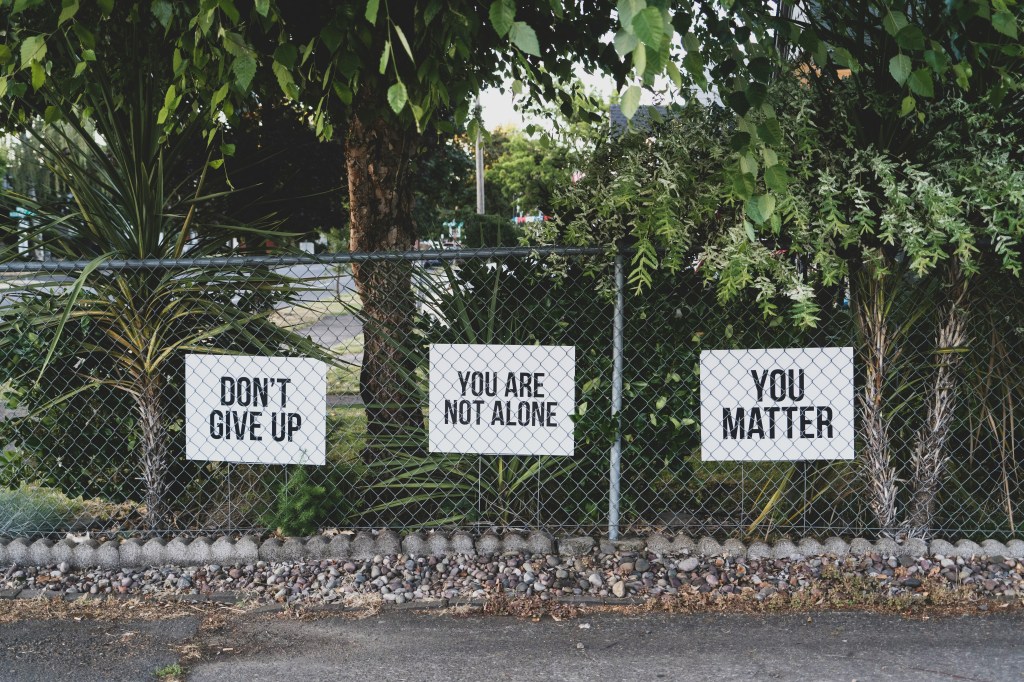
All of those are centered on the person themselves. It is not a guilt driven response, it is an understanding driven response. And you would be surprised at what you will learn if you just listen to them. Allowing them to share will lift their burden and help them find some release, and it will also help you understand them better.
I have a good friend and old coworker who reaches out to me once in a while, just a quick text to tell me he is thinking about me and offering to go on a drive and talk whenever I need to. It is a simple gesture, but it means so much when someone is struggling. It shows someone cares enough to check up on them.
I have had people throughout my adulthood who do this for me, neighbors who have dropped their evening plans to play card games with me when I am struggling, siblings who send a quick text to see how things are going, and my wife who knows when to give me space and when to push back.
I have been lucky to find a network of people who support me. And I have tried to be a part of that network for others as often as I can, because I know how important it is.
There are a lot of dismal statistics about depression and suicide. I don’t want to dwell on those, but I will share some links if you are interested, as well as some resources.
Suicide statistics l Suicide signs l Depression statistics l Depression signs
I can’t share how important it is to ask the hard questions. You will get honest answers if you ask honest questions. So if you are worried about someone, be straightforward with them. I have asked a good amount of people questions like:
“Are you thinking about hurting yourself?”
“Do you feel suicidal?”
“Can I check in with you every few days to make sure you are ok?”
Having been on both sides of those conversations, being open and honest like that is really refreshing. I have felt like I have to lie all day as people ask “How are you today?”, and the option to be honest with someone who wants to really know is empowering.
Because most of us want to get better, but we need help. We need someone to listen, and not someone we have to pay to listen (though we need those professionals as well).
I’m doing well right now. I’m not struggling with suicidal thoughts much anymore, and I honestly believe a lot of that is because I have been getting help. And because of people who go out of their way to remind me that I matter.
Because I matter. And you matter.
I hope you have someone who makes you feel that way.
You deserve it.

 Releasing the Notes
Leave a comment